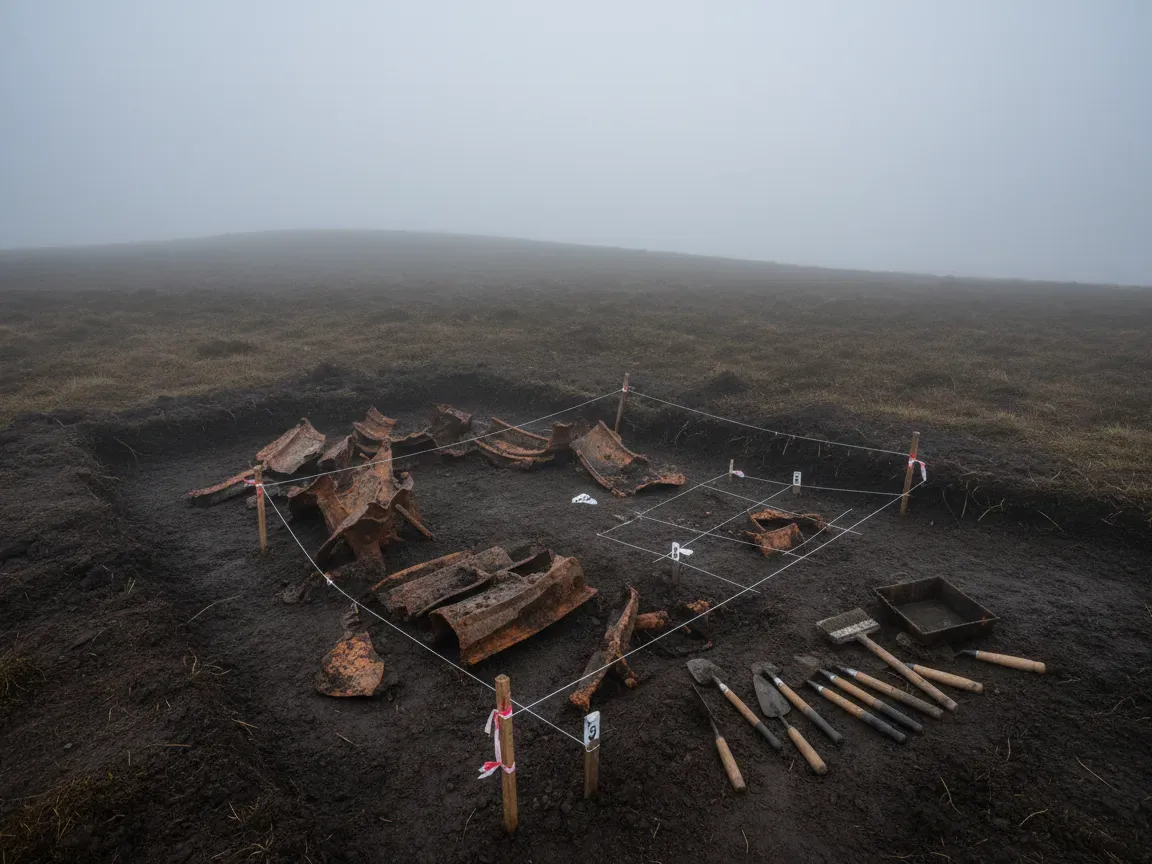
Under the cover of night during World War II, a specially modified American bomber set out on a clandestine mission over Europe, only to crash into the windswept expanse of an English moor. While most of the crew perished and were later accounted for, one young soldier vanished into the peat and mist. Decades later, a dedicated team of forensic specialists and aviation archaeologists has returned to the remote site to uncover the fate of Corporal Clarence Watson.
The Secret Skies of Operation Carpetbagger
Operating in total secrecy, the 801st/492nd Bombardment Group of the United States Army Air Forces conducted some of the most dangerous flights of the Second World War. Known as Operation Carpetbagger, this clandestine initiative worked closely with the Office of Strategic Services (OSS) and the British Special Operations Executive (SOE). Their primary objective was not dropping explosives on industrial hubs, but dropping critical supplies directly to resistance fighters deep behind enemy lines.
To accomplish this, crews flew specially modified B-24 Liberators. The military stripped these heavy bombers of excess weight, painted them glossy black to avoid detection by searchlights, and removed lower gun turrets to install special drop chutes nicknamed “Joe Holes.” The missions required flying at low altitudes through terrible weather and hostile airspace without navigation beacons, relying solely on moonlight and dead reckoning.
Every mission carried enormous risks. Navigators had to spot tiny resistance signals, such as flashlights arranged in triangles across secluded French or Belgian pastures, while avoiding German radar networks and anti-aircraft artillery.
Tragedy on the Moors: The Final Flight of the B-24 Liberator
Not all losses occurred under direct enemy fire. The combination of dense fog, low visibility, and demanding flight profiles made domestic transit in England exceptionally hazardous. During one such night deployment, a Carpetbagger B-24 Liberator ran into severe atmospheric conditions while crossing northern England. Disoriented by heavy fog and poor visibility, the aircraft struck the rising terrain of an isolated moor.
The impact demolished the airframe and ignited a massive fire across the boggy ground. Emergency services and local recovery units rushed to the crash site, but the remote landscape complicated the effort.
- Thick peat and marshland swallowed large fragments of the wreckage.
- Intense fires consumed much of the midsection of the aircraft.
- Bad weather delayed recovery teams from reaching the deepest impact points.
- Multiple crew members died instantly on site.
While the bodies of several aviators were recovered and buried with military honors, the recovery efforts of the 1940s lacked the tools to sift through several feet of submerged, burning marshland completely.
The Decades-Long Mystery of Corporal Clarence Watson
Among the crew members aboard the doomed flight was Corporal Clarence Watson, an assistant radio operator and gunner. In the chaotic aftermath of the crash, searchers recovered the remains of his crewmates, but Watson was nowhere to be found. With no definitive evidence of his survival or his body, the military officially declared him Missing in Action.
For his family back home in the United States, this designation created a painful, open-ended grief. Decades passed with no definitive answers, leaving generations to wonder whether Watson had bailed out miles before the crash, perished in an undiscovered pocket of the wreckage, or was buried deep beneath the moor. The file remained open, but without active physical leads, the case steadily turned cold.
How Modern Archaeology Revives Cold Cases from World War II?
The passage of time often erodes conventional historical evidence, but in aviation archaeology, time can also work in favor of preservation. Peat bogs, like those found across English moors, create an anaerobic environment that preserves organic material, clothing fibers, and metal structures that would otherwise decay in open soil.
Today, recovery operations led by agencies such as the Defense POW/MIA Accounting Agency (DPAA) collaborate with academic institutions and specialized archaeological units to revisit historic crash sites. These teams apply rigorous scientific methods to locations once deemed exhausted:
- High-resolution ground-penetrating radar maps buried metallic anomalies.
- Systematic gridding and micro-excavation techniques preserve delicate context.
- Advanced dry and wet screening separates bone fragments from soil and debris.
- Modern forensic anthropology isolates bone samples for mitochondrial DNA testing.
By combining remote sensing technology with archival flight logs and eyewitness reports, researchers can pinpoint where individual crew stations collapsed during impact. This targeted approach allows archaeologists to recover tiny, degraded bone fragments or personal effects that were entirely undetectable to recovery workers eighty years ago.
The Ongoing Search for Answers Across Forgotten Ground
Renewing the search for Corporal Clarence Watson demonstrates that the passage of decades does not diminish the obligation owed to wartime service members. Each excavation on a windswept hillside bridges the gap between historical documentation and the lived reality of families who spent lifetimes waiting for answers. These missions require immense logistical coordination, specialized forensic training, and respect for fragile local ecosystems, yet the investment reflects an enduring promise to account for every fallen individual.
Aviation archaeology is not merely about salvaging aircraft metal or expanding museum collections. When researchers lift turf and sift through peat, they are actively untangling personal stories cut short by conflict. As forensic teams continue to analyze the artifacts and biological markers unearthed at the English crash site, the prospect of finally closing Corporal Watson’s case turns historical inquiry into an act of enduring dignity.